On this page
On this page
Text and Hex workflows
Use Text mode when the protocol is readable: AT commands, startup logs, console output or line-based messages.
Use Hex mode when the protocol is binary: Modbus RTU, private UART frames, sensor packets, bootloader frames or data that contains non-printable bytes.
Practical checks:
- If text looks garbled, confirm the baud rate first, then check encoding and display mode.
- If a binary command does not work, compare the exact bytes in Hex mode.
- For complete messages, configure Append Line Ending instead of typing invisible characters manually. For terminal-style typing in the receive view, configure Enter Sends separately.
- Keep sample frames with spaces, for example
01 03 00 00 00 02 C4 0B, so they are easier to review.
Text encoding
Text and Hex decide how a message is displayed; the encoding decides which bytes the device actually receives. The two are independent: Chinese devices commonly use GB18030, GBK or Big5, and reading those as UTF-8 produces mojibake — as does the reverse.
Pick the encoding in the Receive Setting and Send Setting groups of the Quick Settings panel, right of the Text/Hex buttons. The Receive and Send pages of the settings dialog carry the same control.
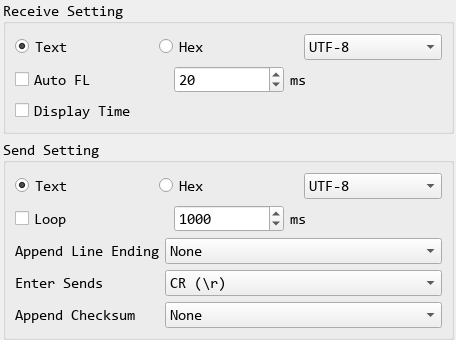
Available: UTF-8, GB18030, GBK, GB2312, Big5, Shift-JIS, EUC-KR, ISO-8859-1, Windows-1252, System.
What to know:
- Receive and send are independent. A device that answers in GBK while you prefer to send UTF-8 is a valid configuration.
- Changes take effect immediately, with no need to reconnect while data is arriving. A half-assembled character is dropped at the switch, which is what changing an encoding should do.
- Hex mode greys the selector out, because hex is raw bytes — but your choice is kept, so switching back to Text restores it.
- A character the encoding cannot represent is refused, not substituted. A device cannot tell a substituted
?from one you typed, so nothing is sent: the status bar names the character and the text stays in the box for you to fix. Thai in GBK is one example. - Log files are always written as UTF-8, independent of the wire encoding, so they stay readable on any machine.
- Checksums cover the bytes actually sent. The same text produces different bytes under UTF-8 and GBK, so the checksum differs too.
To diagnose mojibake, check in this order: baud rate, then Text/Hex mode, then encoding. If ASCII is fine and only Chinese, Japanese or Korean characters are wrong, the encoding is almost certainly the cause.